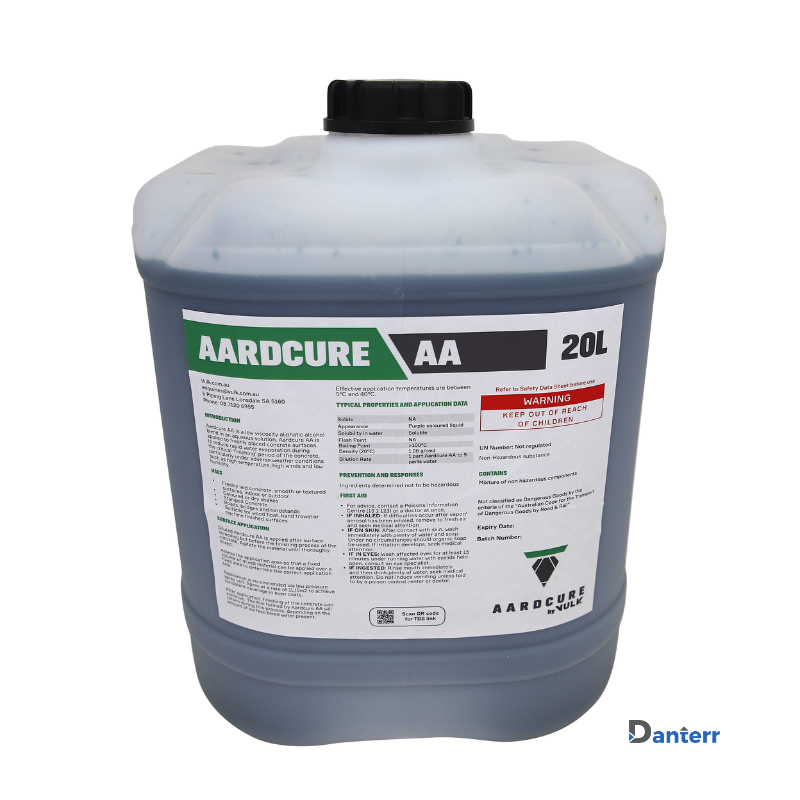
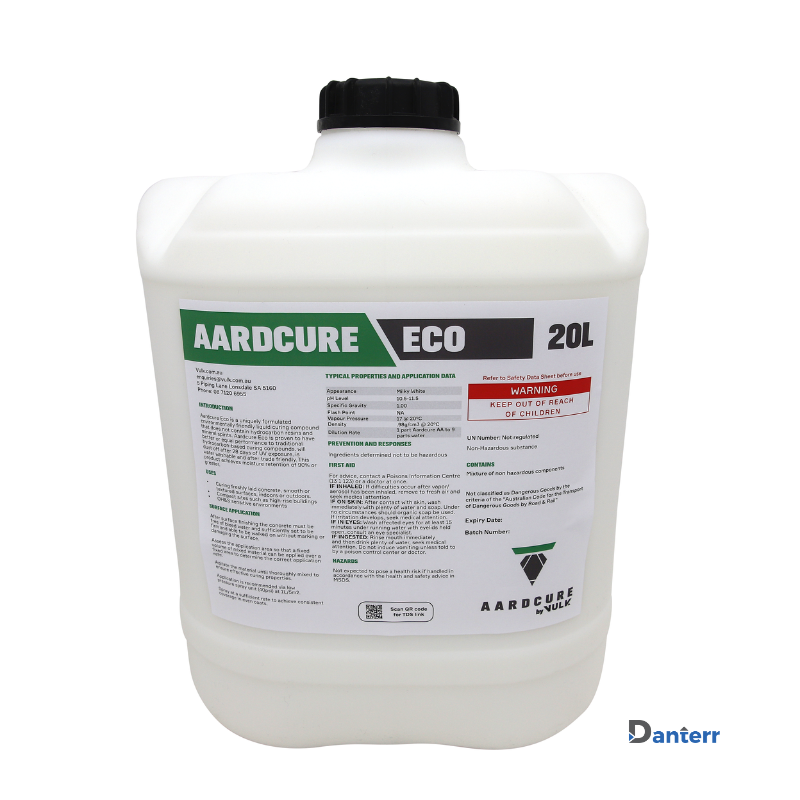
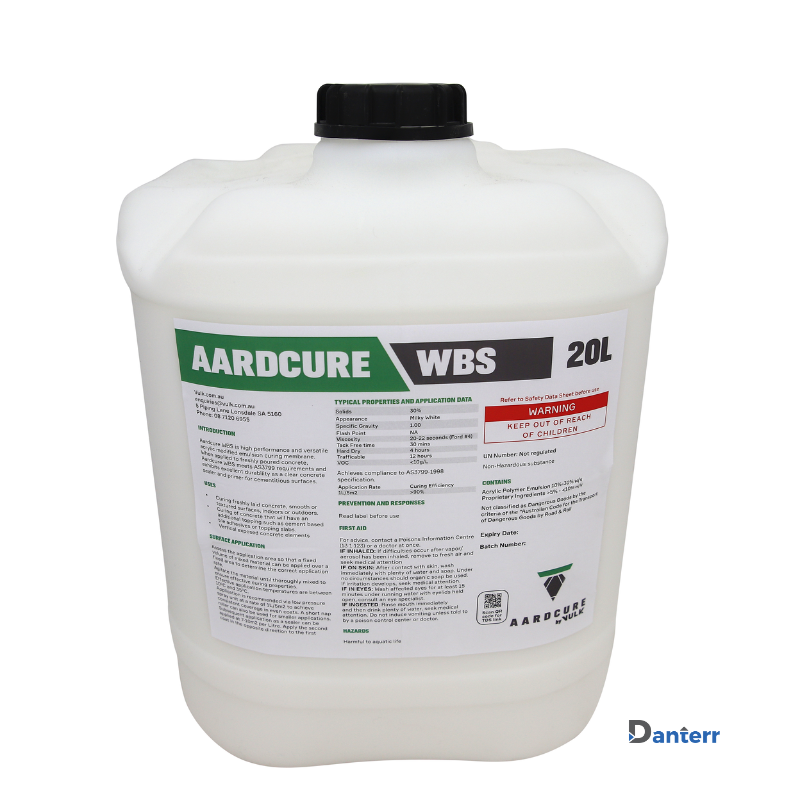
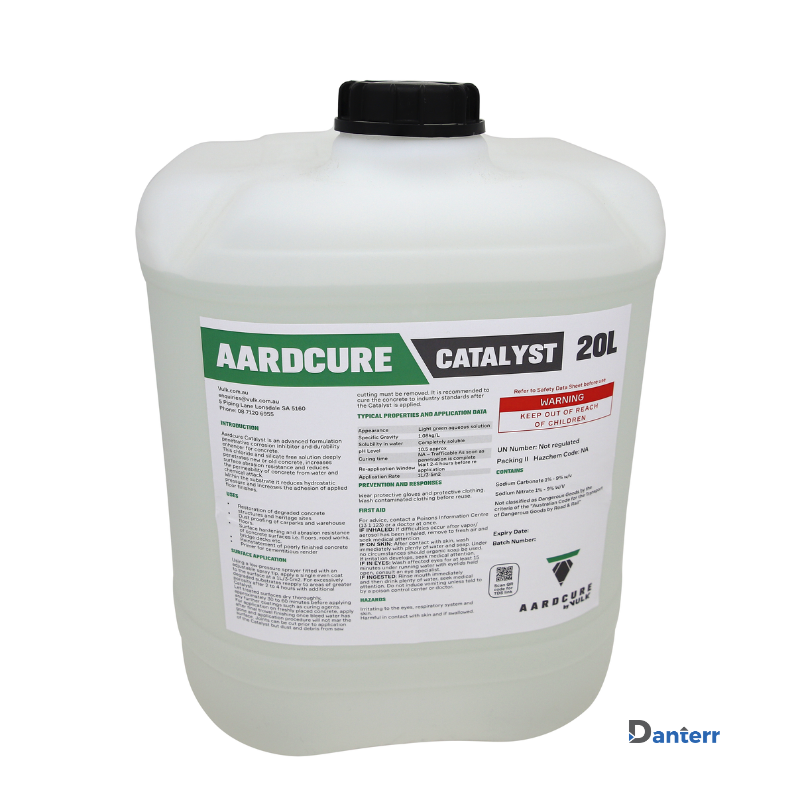
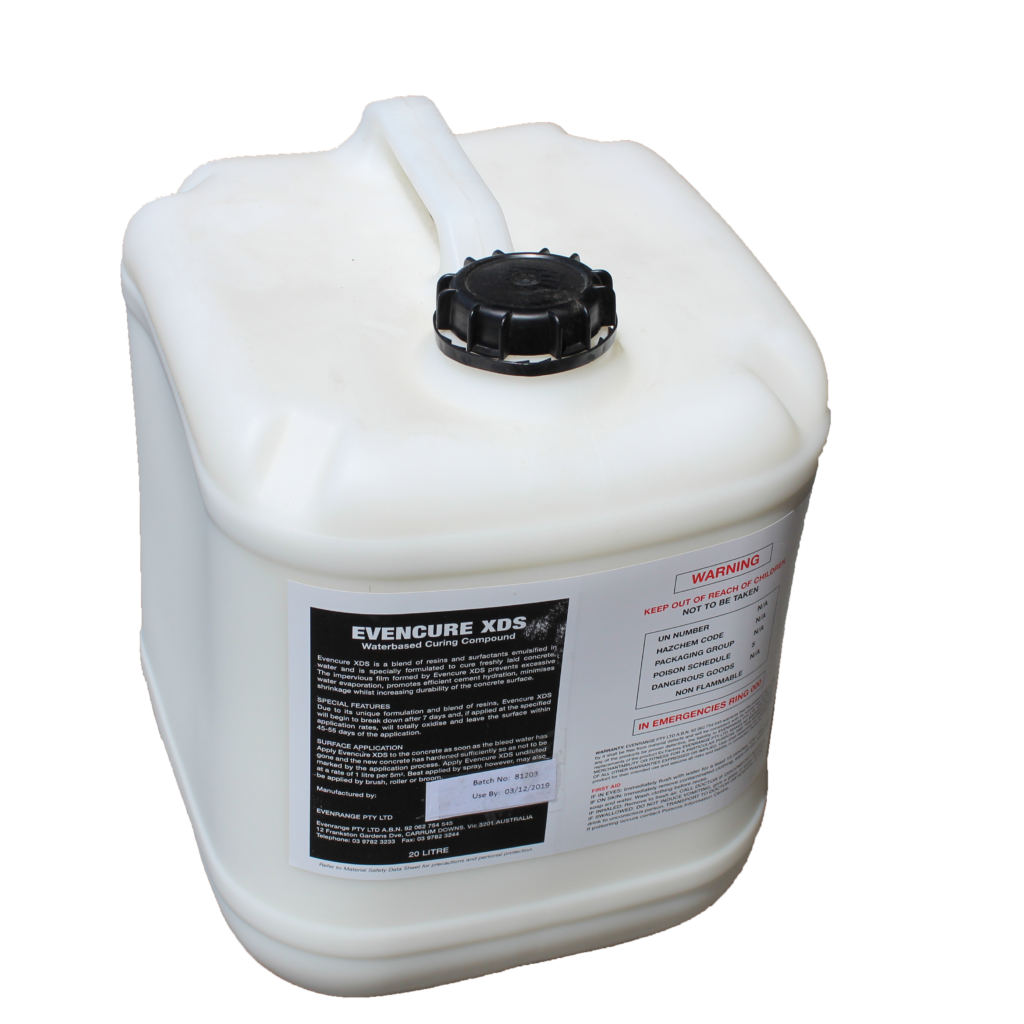
A concrete curing compound is one of the most efficient ways to retain moisture during concrete curing, particularly on large commercial, civil and infrastructure projects. By forming a protective membrane over freshly placed concrete, curing compounds help reduce evaporation, support hydration and improve long-term strength and durability without the need for continuous wet curing.
Selecting the right curing compound for concrete depends on factors such as project size, environmental conditions, surface finish and construction programme. This guide explains how concrete curing compounds work, when they should be used, and how different formulations are suited to specific applications, helping contractors choose the most appropriate solution for every project.
What Is a Concrete Curing Compound?
A concrete curing compound is a membrane-forming concrete curing agent that is sprayed onto freshly finished concrete to reduce moisture loss during the early stages of curing. As the compound dries, it forms a protective film that slows evaporation, allowing cement hydration to continue and helping concrete achieve its intended strength and durability.
Membrane-forming curing compounds used in Australia are typically assessed against AS 3799, the Australian Standard covering liquid membrane-forming curing compounds. Rather than relying solely on manufacturer claims, the standard provides a recognised benchmark for evaluating moisture retention performance, helping contractors compare products with greater confidence when selecting a curing solution.
When applied correctly, a curing compound for concrete helps:
- Reduce moisture loss during curing.
- Support continuous hydration and strength development.
- Improve curing consistency across large concrete surfaces.
- Minimise plastic shrinkage and surface cracking.
- Contribute to long-term durability and surface performance.
Why Use Concrete Curing Compounds?
For many commercial and infrastructure projects, applying a concrete curing compound is one of the most practical ways to achieve consistent curing while improving construction efficiency.
Compared with traditional wet curing methods, curing compounds can be applied quickly using spray equipment, providing uniform coverage across large concrete areas with minimal labour. This makes them particularly suitable for projects where speed, consistency and productivity are important considerations.
Key benefits include:
- Fast application across large concrete pours.
- Consistent moisture retention through a membrane-forming barrier.
- Reduced labour compared with continuous wet curing.
- Suitable for commercial, industrial and infrastructure projects.
- Available in formulations designed for different environmental conditions and surface requirements.
When Should You Use a Concrete Curing Compound?
A concrete curing compound is best suited to projects where maintaining moisture through continuous wet curing is impractical or where large concrete areas require fast, consistent application. By forming a membrane over the concrete surface, curing compounds help reduce evaporation while supporting ongoing hydration and strength development.
Typical applications include:
- Large commercial floor slabs
- Industrial warehouse floors
- Roadways and pavements
- Bridge decks and infrastructure
- Precast concrete elements
- Exposed concrete surfaces where consistent curing is required
Wet curing remains an effective option where continuous surface moisture can be maintained throughout the curing period. However, on large commercial pours or projects where ongoing wet curing is impractical, membrane-forming curing compounds often provide a faster and more efficient method of retaining moisture.
If you’re comparing curing methods, our guide to Wet Curing Blankets: Hessian & Builders Film Explained explores when traditional wet curing materials may be the more suitable choice.
Types of Concrete Curing Compounds
Different concrete curing compounds are designed to suit different construction environments and performance requirements. Understanding how each formulation performs helps contractors select the most appropriate solution before reviewing individual products.
Evaporation Retardants
Before comparing membrane-forming curing compounds, it’s important to distinguish them from evaporation retardants. While both help manage moisture loss, they perform different roles during concrete placement.
Evaporation retardants are applied during concrete placing and finishing to reduce rapid surface evaporation caused by hot, dry or windy conditions. They help maintain a workable surface while finishing is underway but are not designed to replace the concrete curing process.
Water-Based Curing Compounds
Water-based curing compounds form a membrane that reduces moisture loss while offering a practical solution for projects requiring low odour, easy application and environmentally conscious formulations. They are commonly specified for commercial construction, architectural concrete and projects where a cleaner finish is preferred.
Wax-Based Curing Compounds
Wax-based curing compounds provide reliable moisture retention for general concrete construction and remain one of the most widely used curing methods across commercial and civil projects. They are valued for their cost-effective performance on slabs, pavements and large flatwork.
Bitumen-Based Curing Compounds
Bitumen-based curing compounds are designed for projects requiring both moisture retention and compatibility with bituminous overlays. Their durable membrane makes them well suited to infrastructure and heavy-duty civil construction where long-term surface protection is required.
Acrylic and Resin-Based Curing Compounds
Acrylic and resin-based curing compounds provide durable membrane formation while supporting applications where surface appearance, abrasion resistance or extended performance are important considerations. Depending on the formulation, they may also be suitable for exposed architectural concrete or demanding commercial environments.
Hybrid & Advanced Curing Systems
Hybrid and advanced curing systems combine multiple performance characteristics to meet the demands of specialised construction projects. These formulations are designed for environments where durability, abrasion resistance and long-term concrete performance are critical.
Choosing the Right Concrete Curing Compound
Selecting the right concrete curing compound depends on the project’s environment, surface finish, construction programme and long-term performance requirements. Different formulations are designed to address different site conditions, making it important to match the curing compound to the application rather than selecting a single solution for every project.
Every curing compound formulation is designed to solve a different construction challenge. Decorative concrete may benefit from water-based or acrylic formulations, while bridge decks and infrastructure projects often require bitumen-based curing compounds. General commercial slabs commonly use wax-based compounds, whereas warehouse floors and heavy-duty industrial facilities may benefit from advanced curing systems that provide enhanced durability. The comparison guide above helps match typical project requirements with the most suitable curing compound category before selecting a specific product.
Selecting the appropriate formulation helps improve curing consistency while supporting long-term concrete durability and project performance.
How Temperature Affects Curing Compound Performance
While concrete curing compounds help reduce moisture loss, they are not designed to provide thermal insulation or control concrete temperature. During cold weather, hydration slows naturally, meaning a curing compound alone may not provide adequate protection where temperatures are expected to fall significantly.
For projects exposed to cold or changing weather conditions, curing compounds are often used alongside thermal protection systems such as Concrete Curing Blankets or Ecotherm Insulation. Combining moisture retention with thermal protection helps maintain favourable curing conditions and supports consistent strength development.
Our guide to Cold Weather and Concrete: How to Ensure Proper Curing Concrete in Winter Conditions explains when thermal protection should be combined with curing compounds to achieve the best curing outcomes.
Common Mistakes When Using Curing Compounds
Even the most suitable curing compound for concrete can underperform if it is applied incorrectly. Careful product selection and correct application are essential for achieving consistent curing performance.
Common mistakes include:
- Applying the curing compound too late after finishing.
- Uneven spray coverage across the concrete surface.
- Applying the incorrect coverage rate.
- Selecting a formulation that doesn’t suit the project’s conditions or surface finish.
- Assuming curing compounds replace thermal protection during cold weather.
Avoiding these mistakes helps improve moisture retention, reduce curing defects and support stronger, more durable concrete.
Our guide to Concrete Curing Mistakes and How to Avoid Them explores the most common curing errors and practical ways to prevent them on site.
Why Choose Danterr?
Every project presents different curing challenges. Danterr works closely with contractors, engineers and project teams to recommend curing solutions based on environmental conditions, construction methodology and long-term performance requirements, supporting reliable and standards-aligned construction outcomes.
Why contractors choose Danterr:
- Comprehensive range of curing compound formulations for different applications.
- Products designed to comply with relevant Australian Standards, including AS 3799.
- Solutions for commercial, civil, infrastructure and industrial projects.
- Technical support to help select the most suitable curing method.
- Reliable supply backed by nationwide service and industry expertise.
Conclusion
Selecting the right concrete curing compound depends on more than the product itself. Project size, environmental conditions, surface finish and construction requirements all influence which curing method and formulation will deliver the best long-term performance.
While membrane-forming curing compounds provide an efficient solution for many commercial, civil and infrastructure projects, they form just one part of an effective curing strategy. Understanding when to use wet curing, thermal protection or complementary curing methods helps contractors achieve stronger, more durable concrete.
To build a broader understanding of concrete curing, explore our Why Proper Concrete Curing Matters pillar guide, then continue with Wet Curing Blankets: Hessian & Builders Film Explained, Cold Weather and Concrete: How to Ensure Proper Curing Concrete in Winter Conditions, Concrete Curing Mistakes and How to Avoid Them, and The Future of Concrete Monitoring: Faster, Safer, Smarter with Converge. Together, these resources provide practical guidance for selecting the most appropriate curing method before choosing a Danterr curing compound.
Find the Right Concrete Curing Solution for Your Project
Every project has different curing requirements. Speak with the Danterr team to identify the most suitable concrete curing compound for your application, or explore our complete range of curing products and technical resources to support stronger, more durable concrete construction.
 : 1800 262 383
 : [email protected]
Frequently Ask Questions (FAQs)