Maintaining consistent temperatures during concrete curing is essential for achieving the strength, durability and long-term performance required on modern construction projects. Cold weather, overnight temperature drops and exposed site conditions can slow hydration, increasing the risk of delayed strength development and inconsistent curing.
A concrete curing blanket provides a practical thermal protection solution by helping retain heat within freshly placed concrete during the critical early stages of curing. This guide explains how concrete curing blankets work, when they should be used, and how to determine whether they’re the right thermal curing solution for your project.
Why Thermal Protection Matters
Fresh concrete relies on consistent temperature and moisture to support hydration and develop its intended strength. When temperatures fall too quickly, hydration slows, extending curing times and increasing the risk of reduced early-age performance.
Thermal protection helps minimise heat loss during this critical period, allowing concrete to continue curing under more stable conditions. This supports more predictable strength development while helping reduce weather-related delays and long-term durability issues.
For projects exposed to cold or changing weather conditions, selecting the appropriate thermal curing method is an important part of achieving reliable construction outcomes.
What Is a Concrete Curing Blanket?
A concrete curing blanket is an insulated covering designed to retain heat and protect freshly placed concrete during curing. By reducing temperature fluctuations and limiting heat loss, it helps create a more consistent curing environment that supports hydration and early strength development.
Unlike curing compounds or wet curing materials that focus primarily on moisture retention, concrete curing blankets provide thermal protection for projects where maintaining curing temperatures is the primary challenge.
Concrete curing blankets are commonly used for:
- Commercial floor slabs
- Civil and infrastructure projects
- Bridge decks and suspended slabs
- Foundations and footings
- Cold weather and overnight concrete pours
By helping maintain more consistent curing temperatures, concrete curing blankets support stronger, more durable concrete while reducing the risk of weather-related curing issues.
When Should You Use a Concrete Curing Blanket?
A concrete curing blanket is most effective when protecting freshly placed concrete from rapid temperature loss. It helps retain the heat generated during hydration, creating a more stable curing environment that supports strength development and reduces the impact of cold or changing weather conditions.
Concrete curing blankets are commonly used on projects where overnight temperatures, wind or exposed site conditions may affect curing performance.
Cold Weather Concrete
Cold temperatures slow hydration, extending curing times and increasing the risk of delayed strength development. A concrete curing blanket helps retain heat within the slab, allowing hydration to continue while reducing the likelihood of weather-related curing issues.
If you’re planning a winter concrete pour, our guide, Cold Weather and Concrete: How to Ensure Proper Curing Concrete in Winter Conditions, explains how to select the right curing strategy for cold weather.
Large Slabs and Pavements
Large concrete pours can experience uneven heat loss across the surface, particularly during cool evenings or changing weather conditions. Thermal curing blankets help maintain more consistent temperatures, supporting uniform curing across the slab.
Civil and Infrastructure Projects
Bridge decks, suspended slabs, roadworks and other exposed infrastructure projects often require additional thermal protection during curing. Concrete curing blankets provide a practical solution for maintaining curing temperatures while withstanding demanding site conditions.
Danterr Concrete Curing Blanket
Designed for commercial, civil and infrastructure projects, Danterr’s Concrete Curing Blanket helps maintain consistent curing temperatures during cold weather and exposed site conditions. Its insulated construction reduces heat loss during hydration, supporting strength development while helping minimise temperature-related curing issues.
Installation Best Practices
Correct installation helps maximise the performance of a concrete curing blanket and maintain consistent curing conditions throughout the hydration period.
For best results:
- Install the blanket as soon as practicable after finishing operations and once the concrete surface is suitable for covering, helping minimise unnecessary early heat loss.
- Cover the entire concrete surface, ensuring adjoining blankets overlap where required to reduce exposed areas.
- Secure the blanket using the integrated eyelets or suitable anchoring methods to prevent movement caused by wind or site activity.
- Inspect the blanket regularly to ensure it remains securely positioned and continues providing uniform thermal protection.
- Maintain thermal protection until the concrete has reached the required strength or the curing period specified for the project.
Following these installation practices helps create more consistent curing conditions, supporting strength development and reducing the risk of premature temperature-related defects.
Concrete Curing Blanket or Ecotherm: Which Is Right for Your Project?
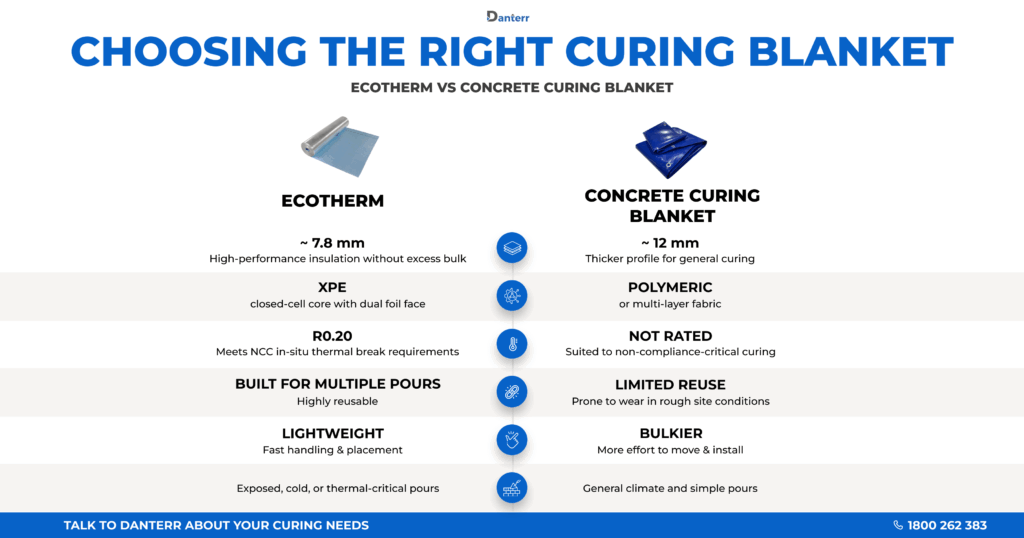
Both Concrete Curing Blankets and Ecotherm help maintain curing temperatures, but they are designed for different project requirements. Choosing the right solution depends on your site’s environmental conditions, thermal performance requirements and construction programme.
In practice, the Concrete Curing Blanket is generally suited to projects requiring straightforward thermal protection during standard cold-weather pours, overnight temperature drops or exposed site conditions. Its flexible construction and simple installation make it a practical option for slabs, pavements and civil applications where maintaining more stable curing temperatures is the primary objective.
Ecotherm may be more appropriate where higher thermal performance is required or where project specifications include specific insulation or thermal break requirements. Its XPE core and reflective foil construction provide a different level of thermal performance for more demanding applications.
Site conditions, expected temperatures, curing duration and project-specific performance requirements should all influence product selection. Where the correct thermal solution is unclear, project requirements should be reviewed before concrete placement.
Common Thermal Curing Mistakes
Even when thermal protection is specified, incorrect installation or planning can reduce curing performance and affect long-term concrete durability.
Common mistakes include:
- Delaying installation after finishing, allowing unnecessary heat loss.
- Leaving sections of the concrete exposed to cold temperatures.
- Removing thermal protection before sufficient strength has developed.
- Selecting a curing method without considering weather forecasts or overnight temperatures.
- Failing to inspect blankets during the curing period to ensure they remain securely positioned.
Planning curing requirements before the concrete is placed helps minimise these risks and supports more consistent construction outcomes.
Our guide to Concrete Curing Mistakes and How to Avoid Them explores the most common curing issues and practical ways to prevent them on site.
Conclusion
A concrete curing blanket provides an effective thermal protection solution for maintaining consistent curing temperatures during cold weather and exposed site conditions. By reducing heat loss during the early stages of hydration, it helps support strength development, improve curing consistency and contribute to the long-term durability of concrete structures.
However, no single curing method suits every project. Understanding your site’s environmental conditions and curing requirements is key to selecting the most effective solution.
For broader guidance on higher thermal performance or projects with specific thermal break requirements, Concrete Curing 101: How to Achieve Perfect Results Every Time explains when Ecotherm Insulation may be the better choice. Where moisture retention is the primary challenge rather than thermal protection, our Wet Curing Blankets: Hessian & Builders Film Explained guide compares traditional wet curing materials and when to use them.
Find the Right Thermal Curing Solution for Your Project
Every project presents different curing challenges. Speak with the Danterr team to determine the most suitable thermal curing solution for your next project, or explore our range of concrete curing products and resources to support stronger, more durable concrete construction.
 : 1800 262 383
 : [email protected]