
Have you ever wondered how large concrete structures maintain their stability and durability over time? The answer lies in a critical but often overlooked component: Dowels. These small but mighty connectors are essential for transferring loads, preventing joint deterioration, and maintaining slab alignment in a wide variety of construction projects.
Understanding the types of dowels available—and how they perform—will significantly enhance the quality and longevity of your structures. Danterr’s versatile dowel range supports the success of construction efforts across Australia, whether for civil, industrial, or commercial use.
What Are Dowels and Why Are They Important?
Dowels are cylindrical rods or bars made from materials such as steel, concrete, or wood, designed to provide structural reinforcement and stability to different elements within a building, such as concrete slabs, walls, and foundations. They are useful in preventing joint deterioration and maintaining the structural alignment of adjoining slabs. Dowels improve the ability of concrete constructions to handle stress and load and enhance the durability and structural integrity of concrete structures.
Key Function of Using Dowels
- Load Transfer: Dowels facilitate load transfer by connecting two adjacent concrete slabs, allowing them to function as a single unit. This helps distribute heavy loads, such as vehicles passing over joints, more evenly and prevents the formation of cracks.
- Expansion and Contraction: Concrete expands and contracts due to temperature fluctuations and other environmental factors. Dowels accommodate these movements by allowing the slabs to shift slightly without damaging the overall structure.
- Joint Stability: Dowels reinforce the joints between different sections of a building, enhancing stability and reducing the risk of displacement, ensuring the structure remains secure over time.
Dowels Available at Danterr

Corrosion-Resistant Galvanised Dowels
Galvanised dowels feature a protective zinc coating to combat corrosion in high-moisture or chemical environments.
Benefits:
- Hot-dip galvanised (≥40 μm zinc)
- Suitable for outdoor, exposed conditions
- AS/NZS 3679.1 and 4680 compliant
Uses:
- Roads, bridges, airport aprons
- Concrete barriers and public walkways
Stainless Steel Dowels
Made from 304 or 316 stainless steel, these dowels offer superior corrosion resistance and long-term structural support.
Benefits:
- High strength and rust resistance
- Mill finish for smooth load transfer
- ASTM A276 (2017) compliant
Uses:
- Marine and coastal infrastructure
- Water-retaining structures
- Industrial slabs and tunnels

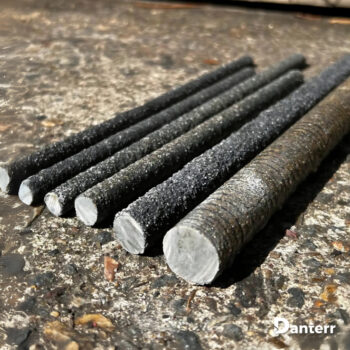
Fibreglass Dowel (GFRP) Dowels
Lightweight yet strong, GFRP dowels are non-metallic, non-corrosive, and ideal for sensitive environments.
Benefits:
- Chemically resistant and non-magnetic
- Up to 6000mm custom length
- ASTM D7913/7913M compliant
Uses:
- Water treatment plants
- Hospitals, data centres
- Roadways and bridges in corrosive zones
Black Steel Dowels
Black dowels are made from high-strength Grade 400 or 500 steel and are friction-cut for better structural performance.
Benefits:
- Friction-cut to preserve grain structure
- Excellent for heavy-duty loads
- AS/NZS 3679.1 compliant
Uses:
- Airport slabs and warehouse floors
- Civil and industrial concrete joints

Enter your email to explore our top-quality construction solutions. We’re here to support your project’s needs with innovative, sustainable products.
Catalogue Form
Projects Featuring Danterr Dowels
- Sydney Gateway Project: Galvanised dowels were used to enhance load transfer and protect joints in high-traffic areas, ensuring long-lasting durability.
- Mona Vale Road East Upgrade: Stainless steel dowels offered very high strength and rust resistance, factors which were essential for the performance of the structure.
- Sydney Light Rail: Fibreglass dowels were used because of their lightweight and non-corrosive properties suitable for harsh conditions.
- Systems Connect Line-wide Tunnel Fit-Out: Dowel cradles kept the structures aligned properly during concreting to provide structural integrity to the building.
- Rozelle Interchange: Heat shrink sleeves were used to protect the dowels from corrosion essential for this complex interchange structure.
- Tolosa Water Supply Upgrade Project: Stainless steel dowels meant the firm’s dowels ensured long-lasting, rust-resistant performance, a crucial factor in the water supply infrastructure.
Best Practices for Dowel Installation
To maximise the benefits of dowels, it’s crucial to follow best practices during installation:
- Proper Alignment: Ensure concrete dowels are properly aligned to promote load transfer and movements.
- Correct Placement: Bury bar dowels to the right depth that is prescribed by the project specifications and ensure that they are properly spaced as required.
- Quality Materials: Use high-quality dowels for concrete joints that meet industry standards to guarantee durability and performance.
Sustainability and Dowels
At Danterr, sustainability is a core aspect of our operations. We understand the significance of practising environmentally friendly measures and strive to supply products that support greener construction. Using dowel joint concrete systems provides concrete structures with improved structural performance as well as sustainability by reducing the need for frequent repairs and replacements.
To learn more about concrete jointing systems and where dowels come in, check out our guide on The Essential Guide to Concrete Jointing Systems in Construction. Also, check out the most innovative materials transforming the industry in our article on Why GFRP Rebar is Transforming the Construction Industry.
Conclusion
Incorporating dowels into your construction projects is a wise decision that enhances structural integrity, improves load distribution, and promotes sustainability. At Danterr, you will find the very best dowels for your projects and most importantly, expert advice to help you complete them. Contact Danterr today!
📞: 1800 262 383
📧: [email protected]
Frequently Asked Questions:
Dowels are used to transfer loads across concrete joints, prevent joint deterioration, and maintain slab alignment, enhancing the durability and stability of concrete structures.
To cut a dowel in half lengthwise, secure the dowel in a vice or with clamps. Use a table saw or a band saw with a fine-toothed blade for a precise cut. Ensure you follow safety precautions, such as wearing protective eyewear and gloves.
To drill a hole in a dowel, mark the desired location with a pencil. Secure the dowel in place, and use a drill with a bit of the appropriate size. Drill slowly to ensure accuracy and prevent splitting.
To remove a dowel, gently tap around the dowel with a hammer to loosen it. Use pliers to grip and twist the dowel out. If the dowel is glued, applying heat with a hairdryer can soften the adhesive, making removal easier.
Danterr offers various dowels, including galvanised dowels, stainless steel dowels, fibreglass dowels, dowel cradles, expansion caps, heat shrink sleeves, and Connolly crack inducers.
Using dowels in construction reduces the need for frequent repairs and replacements, supporting sustainable construction practices by enhancing the structural performance and longevity of concrete structures.
Best practices include ensuring proper alignment, correct placement according to project specifications, and using high-quality dowels that meet industry standards.
Connolly crack inducers control cracking in concrete slabs, ensuring a uniform appearance and maintaining structural integrity. They are ideal for large concrete surfaces where controlled cracking is necessary.
Heat shrink sleeves protect dowels from corrosion, extending their lifespan in harsh environments. They are essential for projects requiring long-term durability, such as those using Danterr’s galvanised and stainless steel dowels.
Stainless steel dowels offer exceptional strength and resistance to rust, making them ideal for both indoor and outdoor applications. They ensure the longevity and performance of structures, especially in projects requiring superior durability.
Stay Updated with Danterr!
Subscribe to Our Newsletter for the Latest in Construction Solutions